END Breed Specific Legislation
Sign Now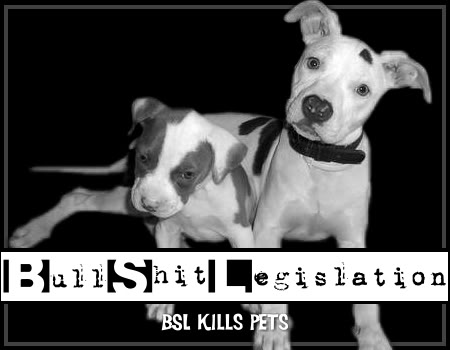
The legislation was speedily introduced in August 1991 following a spate of highly publicised dog attacks.
Kash was seized on July 3rd 2012 because of a complaint that he looked dangerous
The Dangerous Dogs Act (DDA) 1991 is breed specific legislation (BSL) – Section 1 (1) of the legislation refers to four types of dog:
the Pit Bull Terrier
the Japanese Tosa
the Dogo Argentino
the Fila Braziliero
Under section 1(3) it is illegal to keep any of the above types of dog, unless the dog is registered on the Index of Exempted Dogs and certain conditions of exemption are strictly adhered to.
It is a criminal offence for a dog owner to be in possession or custody of any of the listed dogs, unless a certificate of exemption is in force.
Section 1(2) of the Dangerous Dogs Act prohibits the breeding, sale, exchange, advertising, or gift of any dog listed in section 1(1)-prohibited dogs. It also prohibits these dogs from being in a public place with being muzzled and kept on a lead. Abandoning or allowing to stray is also prohibited under this section of the law.
When the law was originally introduced – dog owners had to fulfil certain requirements within a very short space of time in order to bring their dog within the law. There was a deadline given after which time the Index closed and those dogs not fully exempted became illegal.
There were originally 8,200 dogs notified to the Index of Exempted Dogs, by the end of 1992 a total of only 4,821 dogs were on the register and 'legally held'. This figure had dropped to 2,841 when the Act was amended in 1997.
Only a small number of dogs were added to the Index via court order between 1997 and 2006. But, more rigorous enforcement of the legislation in specific areas (London & Merseyside) has led to 185 dogs being added in 2007 and 331 in 2008.
The Index of Exempted Dogs closed in 1991 - it is not possible for a dog’s owner to take their own steps and register their dog, in order to bring it within the law.
The only way a dog can go on the Register is by Court order.
There is no provision for an owner to make an application to a Court themselves.
Sign The Petition
 Continue with Google
OR
If you already have an account please sign in, otherwise register an account for free then sign the petition filling the fields below.
Email and password will be your account data, you will be able to sign other petitions after logging in.
Shoutbox
Goal
64 signatures
Goal: 1,000
Latest Signatures
4 August 2013
4 August 2013
3 August 2013
3 August 2013
3 August 2013
2 August 2013
1 January 2013
14 December 2012
30 November 2012
27 November 2012
26 November 2012
25 November 2012
26 October 2012
25 October 2012
8 October 2012
13 September 2012
2 September 2012
29 August 2012
29 August 2012
25 August 2012
21 August 2012
23 July 2012
21 July 2012
21 July 2012
20 July 2012
Tags
No tags
Embed Codes
direct link
link for html
link for forum without title
link for forum with title
