Save the Teesta
Sign Now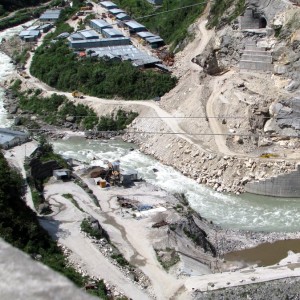
The Central Government’s “master vision” identifies the North-Eastern region as “India’s future powerhouse” by building about 168 dams in the region. To do this, the Teesta river in Sikkim is being extensively dammed. The Sikkim Government, in the pursuit of becoming a power exporter has allowed private developers – some with no experience in the sector – to freely plunder the region's precious resources, with about 35 projects identified. The last stretch of the Teesta river is now under threat of disappearing underground – forever. The cascade of “run-of-the-river” dams built on the Teesta and its tributaries require extensive tunnelling in a geologically, ecologically and culturally sensitive area. Extensive tunnelling in geologically fragile areas, dumping of excavated debris into the surrounding landscape and unevaluated social and environmental impacts, apart from the loss of culturally significant ecologies, make these dams a threat to the local communities, indigenous groups and their way of life. Reports indicate massive irregularities in the way these projects are being handed out, and shocking disregard and callousness for the communities and the natural environment in the way they are being implemented. The real economic and development needs of the communities, that of better healthcare, universal education, communication infrastructure and energy are being sidelined, instead they are being deprived and deracinated as the Sikkim Government aims at becoming a leader in pandering to the private sector. To add to this, there have been very few objective studies done to assess the impacts of such projects on the culture, economy and ecology of the region, depriving the community the means to make informed choices. The heroic resistance that the people of the region have put up since the mid nineties are now being undermined and their victories undone as clearances are being awarded for dam projects that had earlier been scrapped. What is needed now is a collective effort in the form of a sustained campaign by all concerned about democracy, self-determination and environmental and social justice to call for an honest assessment and review of all existing dam projects and scrapping of all proposed projects in Sikkim, to prevent the last stretch of the Teesta, the rights of the indigenous communities and the delicate biodiversity of the region from being violated and irreversibly destroyed.
The MoEF has reversed its earlier decision to scrap all projects and investigations beyond Chungthang in North Sikkim that it had made in light of the CISMHE carrying capacity study. Several dams are being proposed in the Kanchenjunga Biosphere reserve, in the region of Dzongu, the homeland and sacred landscape of the Lepcha tribe. The following demands must be made urgently to prevent the last stretch of the Teesta, the rights of the indigenous communities and the delicate biodiversity of the region from being violated and irreversibly destroyed:
Demands:
1. A moratorium must be declared on all projects in the region until an expert committee is set up by the MoEF to identify and delineate ecologically sensitive areas in the State, and the findings of such a panel must be considered before awarding any clearances.
2. The recommendations of the CISMHE carrying capacity study must be considered before any clearances are awarded.
3. No dams or investigations must be allowed North of Chungthang as per the MoEF’s earlier restriction, that was based on the CISMHE’s carrying capacity study.
4. A cumulative impact assessment of the Rangit River basin, which was not included in the CISMHE’s Teesta study must be carried out, and clearances must be considered and debated only after such a study is completed.
5. There must be a moratorium on large hydroelectric projects within 10 km radius of the Kanchenjunga National Park (KNP), unless prior clearance has been granted by the NBWL. The construction of projects such as the Teesta III, that have not recieved wildlife clearance should be suspended immediately.
6. No individual clearances should be granted within 10 km radius of the Kanchenjunga National Park, unless a cumulative assessment of impacts of these projects on the KNP is carried out first.
7. No dams must be allowed in Dzongu, the last reserve of the ingenious lepcha community.
8. The Teesta IV project must not be allowed to come up, as it is the last free flowing stretch of the Teesta river.
9. All the MOU’s signed between the State and private developers must be made public.
10. The recommendations of the CISMHE study and the Independent Committee on Big Hydro Projects in Sikkim must be considered for people-centric and participatory development alternatives, and if required, a more comprehensive study to determine such sustainable alternatives be undertaken.
Sign The Petition
 Continue with Google
OR
If you already have an account please sign in, otherwise register an account for free then sign the petition filling the fields below.
Email and password will be your account data, you will be able to sign other petitions after logging in.
Shoutbox
Goal
38 signatures
Goal: 1,000
Latest Signatures
28 November 2011
17 November 2011
7 November 2011
5 November 2011
8 October 2011
8 October 2011
7 October 2011
7 October 2011
7 October 2011
7 October 2011
30 September 2011
23 September 2011
9 September 2011
8 September 2011
3 September 2011
1 September 2011
1 September 2011
1 September 2011
30 August 2011
29 August 2011
25 August 2011
25 August 2011
24 August 2011
24 August 2011
24 August 2011
Information
By:
Save Dzongu
In:
-
Petition target:
Ministry of Environment and Forests (MoEF), Government of Sikkim
Ministry of Environment and Forests (MoEF), Government of Sikkim
Tags
No tags
Embed Codes
direct link
link for html
link for forum without title
link for forum with title
